

Import Your Statsig Data
Use GrowthBook’s import tool to migrate your Statsig configuration and experiments.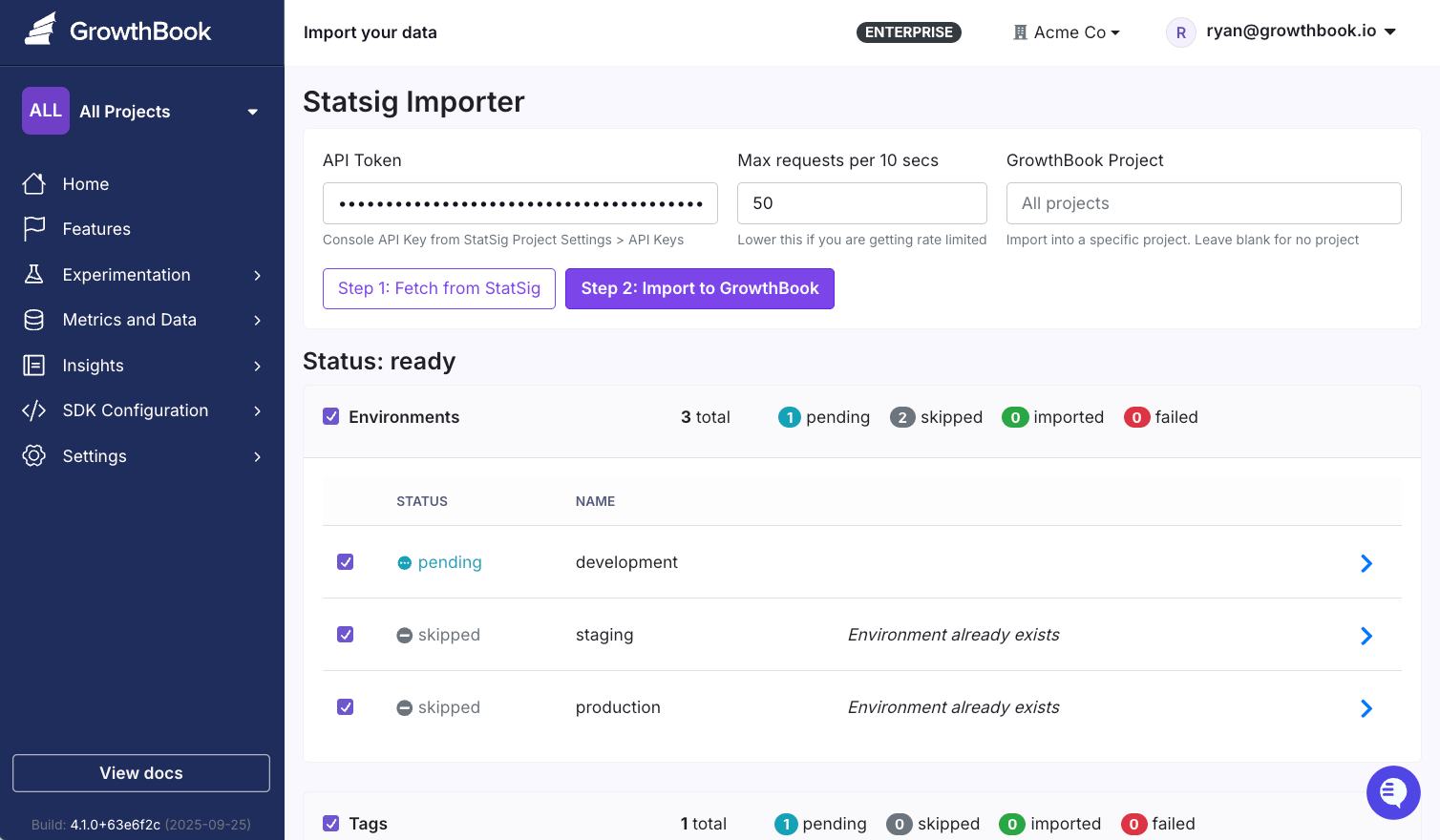
Step 1: Generate a Statsig Console API Key
- In Statsig, go to Settings → Keys & Environments
- Create a new “Console” key with read-only permissions
- Copy the key (it starts with
console-; serversecret-and clientclient-keys will not work)
Step 2: Run the Import
- In GrowthBook, go to Settings → Import your data
- Select Statsig
- Enter your Statsig Console API key
- Choose the GrowthBook project to import into, and select a Data Source if you want to import Metrics
- Click Fetch from Statsig
- Environments (production, staging, etc.)
- Tags
- Segments
- Feature Gates
- Dynamic Configs
- Experiments
- Metric Sources (beta)
- Metrics (beta)
A few things do not come over automatically yet:
- Metrics and Metric Sources require a connected Data Source at import time, and only warehouse-native Statsig metrics are supported
- Imported experiments do not include their metrics or exposure query — assign those in GrowthBook after importing
Step 3: Review and Confirm
Items will show as:- create: New item that will be added to GrowthBook
- update: Item already exists in GrowthBook and will be updated
- skip: Item is unchecked and will be left untouched
- Uncheck items to remove them from the import
- Filter items by tag, or show only new or updated items
- Click the arrow (>) to view an item’s Statsig definition and, for existing items, a diff against what’s in GrowthBook
- Click Import to GrowthBook when ready
Migrate Your SDKs
Automated SDK Migration Use our AI-powered migration assistant to automatically refactor your code from Statsig to GrowthBook SDKs. Supported SDKs- JavaScript
- Typescript
- React (client-side)
Looking for another language? Reach out to support@growthbook.io. We’re happy to help!
Installation
Download the subagent to your Claude Code agents directory:Using the Subagent
In Claude Code, simply ask:“I need to migrate this code from the Statsig SDK to the GrowthBook SDK: (@filename or directory)”The subagent will:
- Convert import statements to GrowthBook SDK
- Transform feature gates to boolean flags
- Migrate dynamic configs to feature values
- Flatten
StatsigUserobjects to GrowthBook attributes - Generate a migration report with any manual steps needed
Terminology Mapping
A Statsig Dynamic Config maps to a GrowthBook feature flag with a JSON value. To get the typed, schema-validated side of a Dynamic Config, back the flag with a Config (Enterprise) — a reusable object that carries a value and a schema, which is enforced on any flag it backs. The import tool creates plain JSON features; attaching a config is a manual step afterward. For simple reusable values shared across flags, see Constants.
Next Steps
- Test your imported features in a development environment
- Assign metrics and an exposure query to your imported experiments
- Configure webhooks and integrations
- Review team permissions and access controls